
Traditional Balsamic Vinegar of Modena: A Living Family Heritage
The True Value Lies in Sharing
A personal story of tasting Traditional Balsamic Vinegar older than its author, shared at a family table in Emilia-Romagna. A reflection on time, care, and living heritage.

There are lunches that stay with us, not because of the food, but because of what is shared.
A few days ago, I visited a home to interview an elderly woman for my YouTube channel, Rezdôre. Three generations were there: grandmother, daughter, and niece. I was happy to meet a family that still cares for our traditions.
After we finished filming, my cameramen and I were invited to stay for lunch. We sat down together to eat what we had made.
A real kitchen. A lived-in table. No staging.
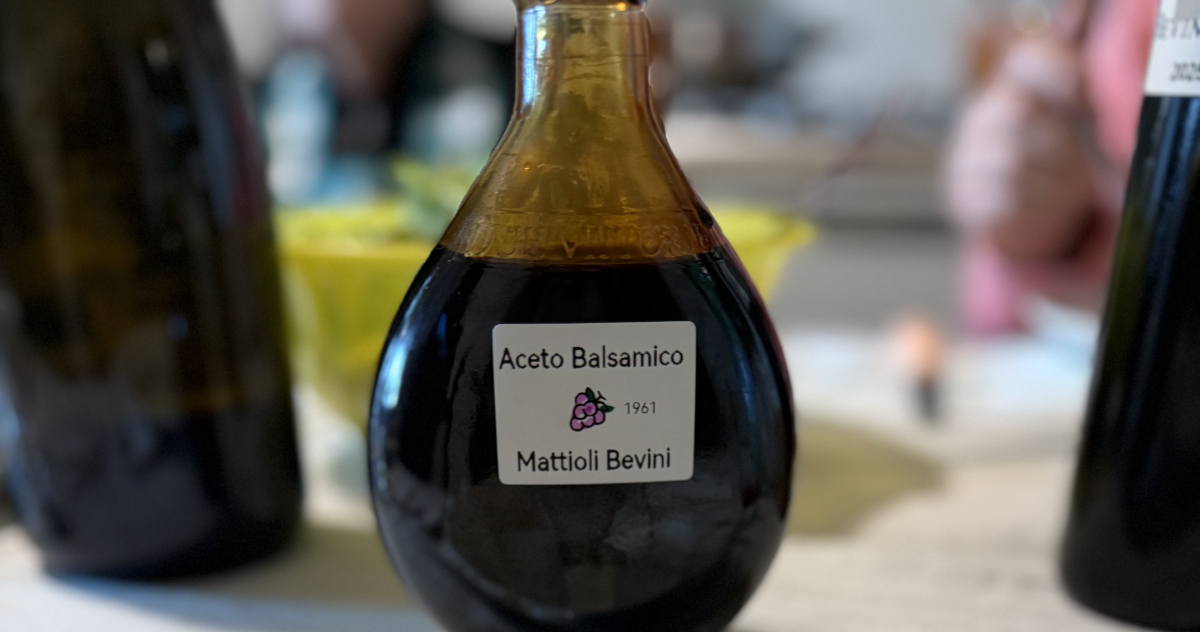
At the end of the meal, with hardly a word, a small bottle appeared on the table. Dark, rounded, with a simple label.
Balsamic Vinegar
1961
Mattioli Bevini
I did the maths.
That vinegar was older than me. I am almost 52, so it is rare to find something on the table that has seen more years than I have.
In that moment, I felt amazed, and above all, grateful.
It wasn’t a condiment.
It wasn’t drizzled “in a thin stream”.
It wasn’t used to add flavour.
It was offered.
One drop on a small piece of Parmigiano.
Nothing more.
True Traditional Balsamic Vinegar does not accompany.
It concludes.
It does not cover.
It illuminates.

How Traditional Balsamic Vinegar Is Genuinely Crafted
To see why that single drop matters, you have to know where it comes from. True Traditional Balsamic Vinegar is not made from wine. It starts with cooked grape must, simmered for hours until it thickens. Then it rests for at least a year.
No haste. No shortcuts.
The must ferments and ages in a set of barrels made from different woods: oak, chestnut, cherry, juniper, mulberry. Each barrel is a bit smaller than the one before.
The Mattioli Bevini family has two sets of these barrels, each with seven. One started in 1961, the other in 1965.
Every year, patiently:
- a small amount evaporates
- a portion is transferred
- time does its work
It takes at least twelve years. In this case, much longer.
Time is the real ingredient.


Barrels Were Not Objects. They Were Promises.
In Modenesi families, a battery of barrels was not started for oneself.
Often it was created to mark the birth of a child.
The new set of barrels was put in the best spot in the attic, away from drafts but not too closed in. Every family knew where their good place was.
A battery of barrels was not meant merely to produce vinegar.
The barrels were not just things to own. They were living inheritances.
There was a phrase often repeated:
“This is not for us.”
It was for the children, the grandchildren, those who would come after.
When a bottle like this from 1961 is opened today, you are not just tasting a product.
You are stepping into a family story that has lasted for decades.
Something to Be Guarded, Not Stored
A vinegar like this is not just stored. It is protected.
That simple act holds a whole unwritten family tradition.
It does not sit on the everyday table.
It is not displayed.
It is kept away from light, moisture, and anything too much.
It is opened only when needed and closed again immediately.
It has already breathed for decades.
A Present, Not a Display
What surprised me was not just how good it was, but how naturally it was shared. I would have expected a balsamic like this to be served in a fancy restaurant with a big bill.
No long explanations.
No display of pride.
Just: “Taste.”
In Emilia, when someone offers you their most precious balsamic, they are not showing you something.
They are letting you in.
Why Do I Tell These Stories?
Rezdôra also exists to share unexpected moments like this with my readers.
Because some things cannot be recreated.
They can only be encountered.
A vinegar older than me, given without fuss, in a real kitchen.
For me, this is living heritage.
This is where I think we should begin, if we want to talk about the future.
